Halving Engineering Overhead: How We Automated Ourselves Out of a Missing Documentation Trap
A practical case study on how a client cut engineering transition overhead by 50% and eliminated technical debt using automated documentation.
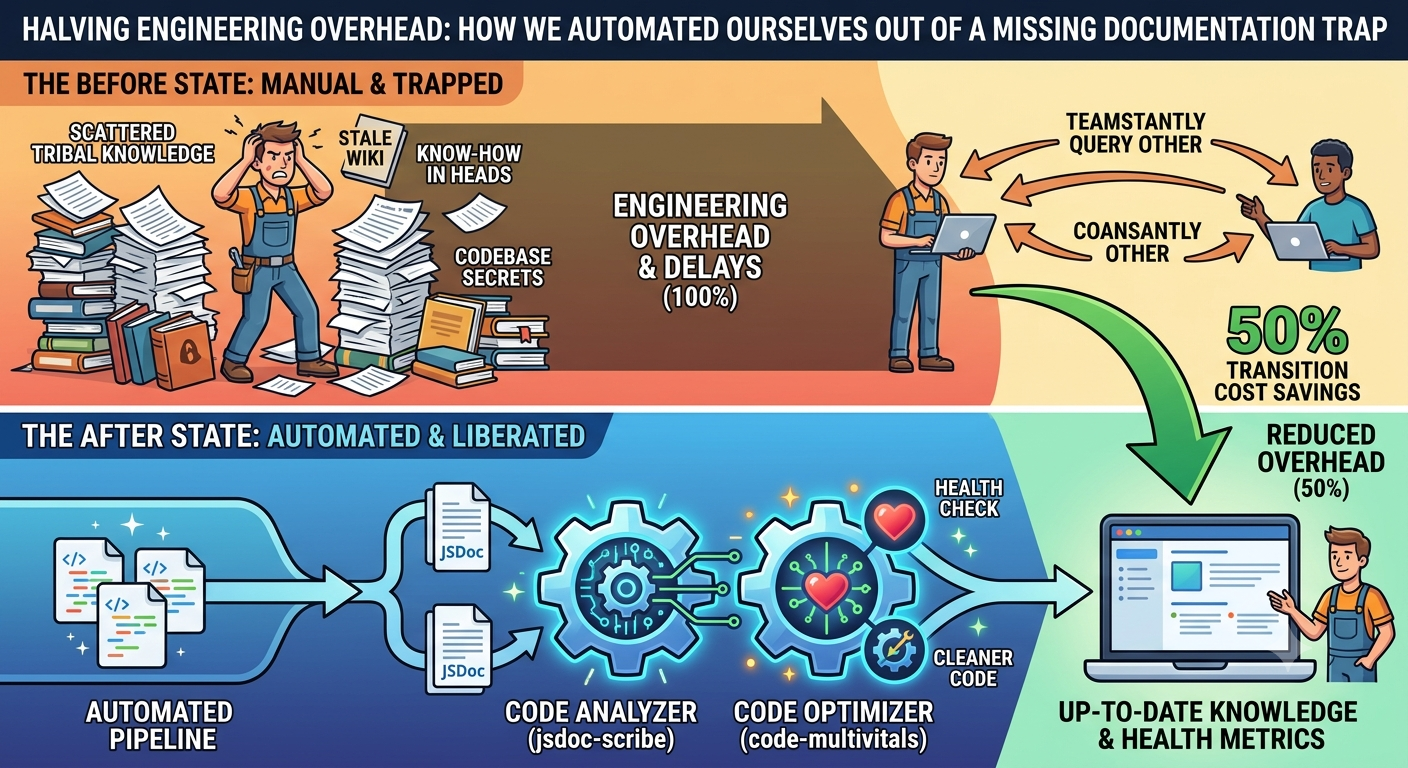
Every engineering leader dreads the "cost-cutting" mandate. But what happens when your organization’s survival depends on trimming overhead, yet your system architecture is locked inside the heads of a few senior developers?
This is the story of how missing documentation held a client hostage, how manual attempts to fix it slashed efficiency, and the automation tool that ultimately cut transition overhead by 50% while saving the team, the budget, and the software itself.
The Corporate Gridlock
The directive from leadership was simple: reduce operational expenditures immediately.
However, we hit a massive structural wall. Over years of rapid development, project documentation had fallen completely by the wayside. The architecture was complex, undocumented, and understood only by a core group of senior staff members whose high compensation packages were the primary targets for budget optimization.
If we transition them out immediately, the business risks a catastrophic failure. If we keep them indefinitely without addressing the underlying issue, we fail the cost-cutting objective.
The Strategy: We structured a compromise. We retained key senior architects to spearhead a massive documentation drive, while gradually restructuring the rest of the team to meet initial budgetary targets. The goal was clear: extract the tribal knowledge, document the entire codebase, and make the engineering team resilient to staff transitions.
The Sinking Ship of Manual Documentation
We set up markdown templates, blocked out dedicated hours in sprints, and urged the remaining team to document functions, API endpoints, and system behaviors.
It was a total failure.
Over the next few months, deadlines started slipping. Engineers hated writing documentation. Senior devs were constantly pulled into fire-fighting mode, leaving markdown files half-written or entirely outdated by the next git commit. The manual effort was actively delaying project deliveries, and the client’s overhead was actually increasing due to the prolonged transition periods.
We were trading one operational headache for an even bigger bottleneck. New engineers joined the team but spent weeks stuck in onboarding limbo because the manual docs were either incomplete or incorrect.
Manual documentation is a losing battle where engineers spend more time syncing markdown files than writing features.
Enter jsdoc-scribe
Just as the situation felt completely gridlocked, our engineering lead introduced a tool that shifted our entire approach: jsdoc-scribe.
Instead of treating documentation as a separate, manual chore, jsdoc-scribe seamlessly automated the entire generation process straight from our codebase. By reading structural code architectures, types, and comments, it generated comprehensive, up-to-date, and interactive developer documentation automatically on every build.
The impact was instantaneous:
- Zero Overhead: Developers went back to focusing on feature engineering.
- Always Up-to-Date: The documentation evolved continuously alongside our code changes.
- Rapid Onboarding: New engineers who came on board skipped the weeks-long code-combing phase. With crystal-clear, automated documentation, their onboarding time plummeted by over 70%, allowing them to ship code in their first week.
Beyond Words—Achieving Code Health with `code-multivitals`
What we didn't expect was the secondary superpower bundled within this automation ecosystem. jsdoc-scribe didn't just document what the code did; it integrated deeply with code-multivitals to monitor what the code felt like.
While parsing the repository to build the documentation, the engine analyzed structural health, providing core metrics on:
- Code Optimization: Highlighting redundant logic loops and memory-heavy operations.
- Code Quality & Maintainability: Flagging high cyclomatic complexity and deeply nested logic.
- Project Delivery Metrics: Spotting technical debt hotspots before they caused deployment bottlenecks.
Suddenly, we had a mirror held up to our codebase. As the automated documentation grew clearer, our code became cleaner, leaner, and significantly more optimized.
The Ultimate Win-Win-Win
With the documentation headache permanently solved and engineering efficiency soaring, the saved budget was finally unlocked. Instead of blindly slashing resources, the client achieved a 50% reduction in engineering transition overhead, allowing them to reallocate those saved funds into high-impact product features and strategic market growth.
The transformation brought an elusive corporate alignment where everybody won:
- The Client Was Happy: The operational budget was optimized, project delivery accelerated, and the reliance on individual "gatekeepers" was eradicated.
- The Team Was Happy: No more manual documentation marathons. Developers got to focus on writing clean, high-performance code, backed by deep automated insights.
- The End Users Were Happy: Thanks to the codebase optimization driven by
code-multivitals, the end application became faster, highly stable, and bug-free.