SyntaxScribe vs jsdoc-scribe: Two Honest Answers to "Generate My Docs"
SyntaxScribe is the clearest name-adjacent competitor we've found in sixteen days of tracking — a real product with its own domain, showcase sites, and a Medium tutorial. Here is a sourced, feature-by-feature look at where it actually differs from jsdoc-scribe, and where it doesn't.
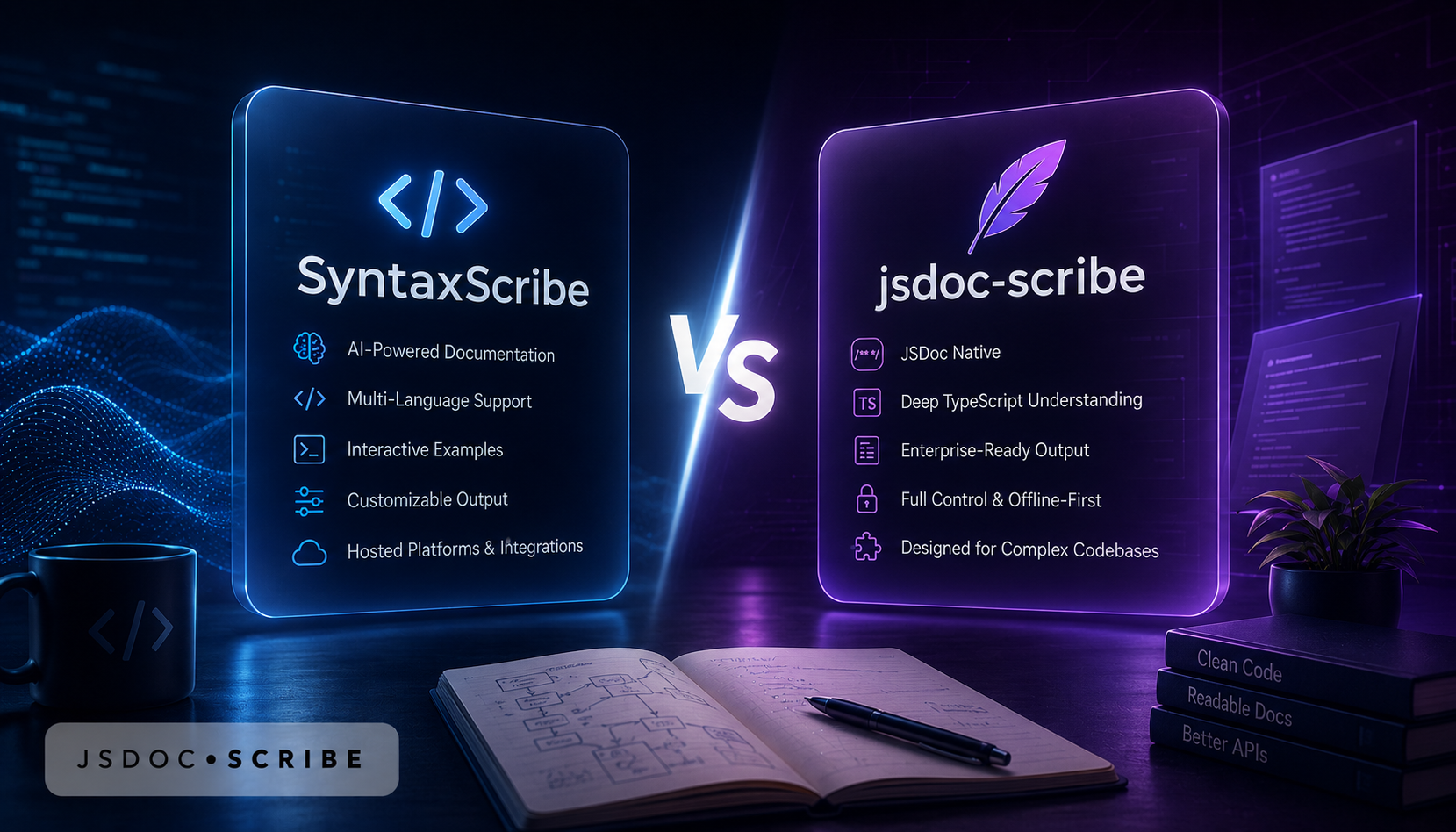
Most of the tools we've mentioned in prior posts — TypeDoc, Docusaurus, Storybook — solve a documentation problem, but not quite this problem: "point a CLI at my JS/TS source and get a browsable docs site out, with no manual authoring step." SyntaxScribe does. It's also, as far as we can tell, the first tool we've found that occupies almost the exact same search intent as jsdoc-scribe, has its own indexed domain, and has real third-party coverage (a full Medium walkthrough). That combination is rare enough that it's worth a direct, sourced comparison rather than a passing mention.
Everything below is checked against SyntaxScribe's own site and docs as of this writing, not assumed. Where something is genuinely unclear from public sources, we say so instead of guessing.
What SyntaxScribe actually does
Install it globally (npm install -g syntax-scribe), point it at a source directory, and it walks your JS/TS/Vue/JSX files and emits Markdown documentation — functions, classes, interfaces, types, imports, exports, and more, according to its own feature list. From there, an optional second step (--prepareMkdocs) wraps that Markdown in MkDocs — a Python-based static-site generator — either running it locally in Docker or building static files for GitHub Pages, Netlify, or any static host.
Its own showcase page documents three real open-source codebases run through the tool — VueUse (769 files, 1.23s), typescript-eslint (2,454 files, 2.51s), and Three.js (1,533 files, 30.42s) — with the resulting sites hosted live on GitHub Pages. That's a meaningfully more concrete "does this actually work at scale" proof point than most dev-tool marketing sites offer, and worth acknowledging directly.
Pricing: a Free tier covers the full documentation and MkDocs-generation feature set — Markdown generation, TypeScript/JavaScript/Vue/JSX parsing, class/interface/enum/type-alias parsing, and the MkDocs site build. A $5/month (billed yearly) "Team" tier adds raw JSON analysis output for custom reporting on top of that. So it isn't a paywalled tool in any meaningful sense — the core "generate my docs" workflow is free, same as jsdoc-scribe.
Where the two tools genuinely differ
Documentation source: inferred vs. authored-and-verified. SyntaxScribe's default mode generates documentation from code structure without requiring comments at all — its own JSDoc comparison post describes this as "smart analysis" that "recognizes mathematical operations" and can "infer documentation from your code structure." An optional --useJsDocs flag has it read existing JSDoc comments instead. jsdoc-scribe runs the other direction by default: it reads your TypeScript/JS AST and writes real JSDoc comment blocks into your source (types, params, returns, pulled directly from the AST, not inferred prose), and its --check-drift mode fails CI when an existing JSDoc block no longer matches the function's actual signature. One approach treats documentation as a generated artifact you regenerate each time; the other treats it as source-of-truth comments that get verified, not just produced. Neither is strictly better — a team that doesn't want JSDoc comments living in its source at all will prefer SyntaxScribe's default; a team that wants comments as a build-verifiable contract will want jsdoc-scribe's.
Toolchain: single Node dependency vs. a Python/Docker step. jsdoc-scribe's static-site output (gen-docs) is a self-contained Node script — one runtime dependency (typescript, used only as a parser), no second language, no Docker requirement. SyntaxScribe's Markdown output is dependency-light too, but turning it into a browsable site pulls in MkDocs (Python) and, for one of its three documented workflows, Docker. If your team already runs a Node-only pipeline, that's a real toolchain difference worth knowing before you pick either tool — not a knock on SyntaxScribe's approach, which has its own upside (MkDocs' Material theme, search, and plugin ecosystem are genuinely more mature than anything jsdoc-scribe ships on its own).
AI usage: neither claims it, but the framing differs. We looked specifically for an AI/LLM claim on SyntaxScribe's site and didn't find one — its homepage explicitly states "All parsing happens locally — your code stays on your machine," which reads as a non-AI, non-network claim consistent with jsdoc-scribe's own "no AI, no network calls" positioning. The one open question is language like "smart analysis" and "intelligent analysis" scattered through its marketing copy, which is vague enough that we can't confirm from public sources whether it's describing heuristic AST pattern-matching (most likely, given the "recognizes mathematical operations" example) or something closer to a model. We're not asserting it uses AI — we don't have evidence either way beyond that ambiguous copy — and we'd rather flag the ambiguity than overstate a difference we can't back up.
Scope: single-repo vs. workspace-native. As of public information available to us, SyntaxScribe's own materials don't describe a documented monorepo/workspaces mode the way jsdoc-scribe's Architecture Insight page (which detects an npm workspaces field automatically) and programmatic generateSite() API (built for looping across packages/*) do. This may simply not be a workflow SyntaxScribe targets yet rather than a gap — we're noting what we found documented, not claiming an absence is permanent.
Ecosystem signal: SyntaxScribe currently has more of it. This is the uncomfortable one to write, but it's the reason this post exists. SyntaxScribe has its own marketing domain, a docs microsite, a blog, three real showcase deployments, and independent third-party tutorial coverage. jsdoc-scribe, across sixteen consecutive discoverability checks, has none of that yet. That gap isn't a product gap — it's a visibility gap — but it's real and worth naming plainly rather than only comparing feature lists.
Quick reference
| | jsdoc-scribe | SyntaxScribe | |---|---|---| | License / cost | MIT, fully free | Free tier covers full doc generation; $5/mo team tier adds JSON export | | Runtime dependency | 1 (typescript, parser only) | Not independently verified; Markdown step is Node, MkDocs step adds Python (+ optional Docker) | | Default doc source | AST-derived JSDoc comments, written into source | Structural inference from code; JSDoc comments optional via flag | | Drift checking | --check-drift fails CI on stale comments | Not documented publicly as of this writing | | Site output | Self-contained static HTML, pure Node | Markdown → optional MkDocs site (Python/Docker) | | Code-quality dashboard | --quality via code-multivitals | Not documented publicly as of this writing | | Monorepo/workspaces support | Automatic detection + generateSite() loop API | Not documented publicly as of this writing | | ESLint integration | Dedicated eslint-plugin-jsdoc-scribe | Not documented publicly as of this writing | | Framework support | JS/TS, Vue SFC | JS/TS, Vue SFC, JSX/TSX | | Public indexed presence | Near-zero (16 checks, no third-party mentions) | Own domain, docs site, blog, third-party tutorial |
The honest takeaway
If you want documentation that's inferred from code with minimal ceremony and you're fine adding a Python/Docker step to get a polished MkDocs site, SyntaxScribe is a real, working option — the VueUse/ESLint/Three.js showcases back that up. If you want your JSDoc comments themselves to be the generated, verified artifact — written into source, checked for drift in CI, with a code-quality dashboard and native workspace support — that's the problem jsdoc-scribe is built around, in a single Node dependency with no AI calls either way.
We'll keep tracking SyntaxScribe (and anything else that shows up) as part of our ongoing discoverability checks, and we'll correct this post if any of the "not documented publicly" rows above turn out to be wrong — reach out if we got something about SyntaxScribe incorrect here.
npx jsdoc-scribe . --write            # try jsdoc-scribe once, no install
npm install --save-dev jsdoc-scribe   # add it to the project
Full docs at the jsdoc-scribe documentation site, package on npm, source on GitHub.
Sources: Syntax Scribe — JavaScript Documentation Tool · Syntax Scribe Pricing · Syntax Scribe vs JSDoc — Syntax Scribe Blog · Syntax Scribe Showcase · From Code to Beautiful Docs: A Complete Syntax Scribe Tutorial — Medium · internal: package.json, lib/docs.d.ts (this repo)