The Due Diligence Blind Spot: Why Investors Read Your Docs Before They Read Your Code
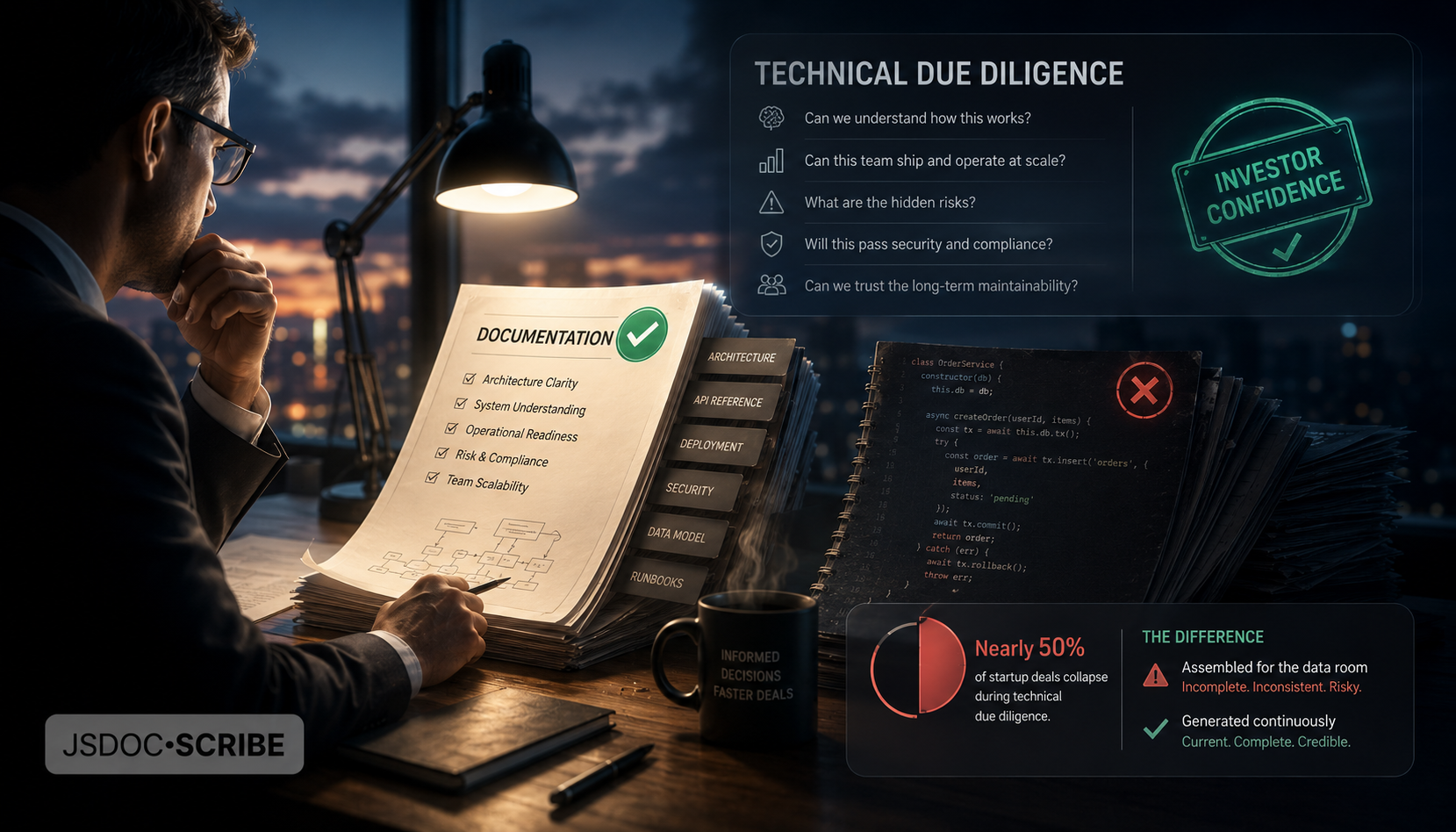
Nearly half of startup deals collapse during technical due diligence. Here's why documentation quality — not code quality — is often the tell reviewers act on, and what changes when it's generated continuously instead of assembled for the data room.
Every founder preparing for a raise or an acquisition budgets time for the pitch deck, the financial model, and the data room. Almost none budget time for their JSDoc comments. That's a mistake, and the data on why is more specific than most engineering leaders expect.
The number that should change how you prepare
Technical due diligence isn't a formality — it's a filter. Depending on the source, close to half of startup deals that reach diligence don't survive it. The process itself isn't cheap either: reviewers typically bill 0.2–4% of deal value, which lands around $25K–$75K at seed stage and $50K–$200K or more at Series A or acquisition. That's real money spent specifically to find reasons not to close, and the reviewing team spends a meaningful chunk of that budget doing one thing first: reading your code before they read your PRD.
What they're actually assessing isn't just "does this work." It's whether the system can handle growth in users, data, and integrations; whether access controls, monitoring, and incident response exist; and whether the architecture lives in the codebase or only in a few people's heads. Documentation is the fastest proxy for all three.
The tell experienced reviewers already know how to spot
Here's the detail that should worry any founder who's planning to "clean up the docs before the raise": experienced diligence teams can tell when documentation was written for them. It shows up as inconsistent depth — polished in the modules someone remembered to touch, thin or absent everywhere else — because it was assembled in a sprint, under deadline pressure, by people who were also trying to close their actual engineering work at the same time.
Documentation that was built continuously, as a byproduct of normal engineering practice rather than a pre-raise fire drill, reads completely differently. It's even in coverage. It matches the code that's actually running, not the code that was running when someone last had time to update a wiki page. And critically, it doesn't have a "prepared on" date that lines up suspiciously with the term sheet.
Reviewers aren't just checking a documentation checkbox. They're using documentation quality as a low-cost signal for something much harder to assess directly in a two-week diligence window: does this engineering org actually operate with discipline, or did it just perform discipline for an audience.
Why "generate it right before the raise" doesn't work
The instinct to schedule a documentation sprint before diligence starts is understandable, but it fights the exact signal reviewers are trained to detect. A six-month pre-raise checklist that includes "code cleanup, IP audit, and documentation" as a line item is common advice — and it's not wrong, exactly. But documentation that's authored by hand under a deadline still carries the fingerprints of being authored by hand under a deadline: gaps around whatever got deprioritized, drift the moment the next PR lands after the audit closes, and inconsistent voice across whoever got assigned which module.
There's also a timing problem nobody plans for: diligence doesn't wait for you to be ready. An inbound acquisition offer, an accelerated round, a key investor asking for a data room on short notice — none of these come with six months of lead time. If your documentation is only ever as good as your last scheduled cleanup, you're gambling on the deal happening to land right after one.
What changes when documentation is generated, not written
This is the actual argument for AST-based documentation tooling like jsdoc-scribe, and it has nothing to do with saving engineers typing time — that's a separate benefit. The due-diligence case is about when the documentation is accurate.
Documentation generated from the code's actual Abstract Syntax Tree, on every build, is accurate at every commit — not just the ones somebody remembered to document by hand. There's no gap between "what the docs say" and "what's actually deployed," because the docs are derived from what's deployed. If diligence starts tomorrow instead of in six months, the documentation is exactly as current as it would have been on the date you'd planned to prepare for it. That's the property reviewers are actually looking for when they say they can tell the difference between habitual and performed documentation: consistency over time, not a good week.
There's a second, quieter due-diligence detail worth naming directly: source code confidentiality. A growing share of documentation tooling in 2026 works by sending your source to a third-party LLM to generate prose descriptions — which means during the exact window when your IP ownership and confidentiality practices are under the most scrutiny, some teams are routing their proprietary code through an external API to produce the documentation meant to demonstrate engineering discipline. Tooling that reads the AST locally and never sends code anywhere sidesteps that question entirely; there's nothing to disclose in the security review because nothing left the build environment.
A short list for the next six months, not the next six weeks
If a raise or acquisition conversation is anywhere on your horizon — even a vague one — three things are worth doing now rather than when a term sheet shows up:
- Wire documentation generation into CI, not into a pre-raise task. If it runs on every merge to main, "when's diligence" stops being a scheduling problem.
- Check for drift, automatically. A CI gate that fails when code and docs diverge (
--check-drift-style tooling) catches the exact inconsistency pattern reviewers are trained to notice, before it accumulates. - Keep the generation process boring and explainable. "We run a deterministic, local AST parser on every build" is a one-sentence answer in a security review. "We periodically ask an AI to summarize the codebase" invites three more questions you don't want asked under time pressure.
The bottom line
Documentation doesn't close deals by itself, and no reviewer is going to greenlight a deal purely because the API reference looks tidy. But it's one of the cheapest, most controllable signals in the entire diligence process — and unlike your revenue numbers or your market size, it's entirely within engineering's power to get right, continuously, starting today, for the cost of wiring a generator into a build pipeline that already exists.
npx jsdoc-scribe . --write            # see what's actually undocumented, right now
npm install --save-dev jsdoc-scribe   # wire it into CI before you need it to be
jsdoc-scribe is free, MIT licensed, and 100% local — no source code leaves your build environment, ever. Full docs at imchintoo.github.io/jsdoc-scribe, package on npm as jsdoc-scribe, source at github.com/imchintoo/jsdoc-scribe.